
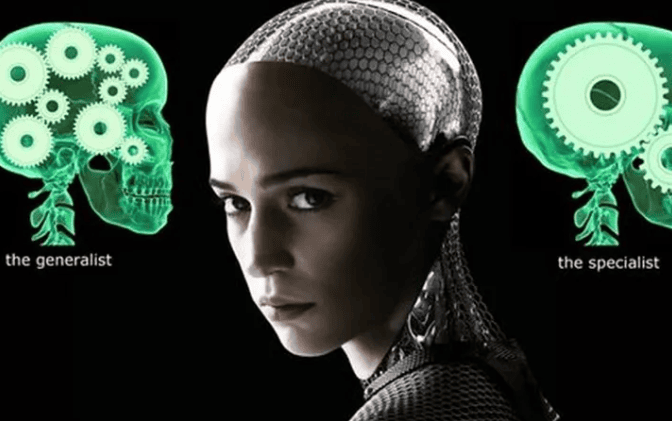
There was a time when the highest-value professional in any organization was the specialist. The person who knew one thing better than anyone else. The machinist who could hold tenths all day. The marketer who only did SEO. The sales professional who only closed. The operations manager who only optimized throughput.
Businesses were built around these narrow pillars of expertise. Depth was everything. But something fundamental has shifted. AI is now the specialist. And humans are becoming most valuable where AI is not: at the intersections.
AI Has Changed the Economics of Expertise
AI can now generate code, analyze markets, draft campaigns, model processes, and synthesize technical information instantly. It can go deep, fast. What it cannot do, at least not independently, is understand how all the pieces of a business work together in the real world.
It cannot walk the floor and see how a quoting delay affects production scheduling, which affects delivery timelines, which affects customer retention, which affects cash flow. It cannot align sales, marketing, and operations culturally and operationally. It cannot build trust. It cannot see the system holistically.
That is where the modern generalist thrives. Not as a jack-of-all-trades without depth but as an integrator of multiple disciplines.
My Own Shift From Marketer to Growth Strategist
I didn’t set out to become a generalist. I became one because growth required it. I started in marketing. But marketing alone doesn’t grow companies. To scale startups and industrial businesses, I had to learn business development and sales, basically how revenue is actually created, not just promoted.
I earned a Sandler Bronze Certification and did a year of weekly Sales Mastery meetings to understand how buyers make decisions and how sales systems create predictable outcomes.
I applied Lean Six Sigma to marketing and sales processes to remove friction, improve conversion, and increase throughput.
During my career, I have managed projects because strategy without execution is theater. I am Type A, like to get stuff done, move like a, well, a barracuda or a locomotive, am efficient and effective, and like to be structured and time managed. To me, it’s about exceeding expectations and beating deadlines.
I worked alongside leadership teams to align operations, marketing, and sales around shared outcomes.
Over time, something changed. I stopped seeing functions. I started seeing systems. Revenue is not created by marketing alone. Or sales alone. Or operations alone. Revenue is created by alignment.
When those functions operate in silos, growth stalls. When they operate as a system, growth accelerates. That perspective is where the real leverage lives.
Why Generalists Are Now a Strategic Advantage, Especially for Startups
Startups and small manufacturers live with constraints that large corporations do not. They can afford one six-figure salary. They cannot afford eight.
They don’t need:
- A VP of Marketing
- A Sales Director
- A Process Improvement Leader
- A CRM Architect
- A Project Manager
- A Business Development Lead
- A Data Analyst
- A Strategic Planner
They need someone who understands how those roles connect. Someone who can:
- Build the growth strategy
- Implement the systems
- Align teams
- Improve processes
- Enable sales
- Use AI as leverage
- And execute
This is not about replacing specialists entirely. Specialists remain essential. But early-stage and growth-stage companies need integrators first. Because without alignment, specialization creates fragmentation. And fragmentation kills momentum.
AI Amplifies the Generalist
AI doesn’t replace the generalist. It amplifies them. A generalist who understands marketing, sales, operations, and process improvement can now use AI to execute faster in each domain. AI becomes the tactical specialist. The human becomes the strategic orchestrator.
This is the new leverage model. One aligned generalist using AI can produce the output that previously required an entire team. Not by working harder. By working across the system.
Manufacturing Has Always Valued Systems Thinkers
Manufacturing intuitively understands this. A production system is only as strong as its weakest constraint. Growth works the same way. You don’t fix growth by optimizing one department. You fix growth by aligning the entire value stream from first touch to final delivery.
This is why the future belongs to leaders and operators who can move fluidly across functions, see interdependencies, and remove friction wherever it exists. People who can connect strategy to execution. People who understand both the machine and the market.
The New Definition of Expertise
Expertise is no longer defined solely by how deep you go in one area. It is defined by how effectively you connect multiple areas into a cohesive, aligned system. The companies that will grow fastest in the AI era will not be those with the most specialists. They will be those with the strongest integrators.
Because growth has never been about isolated excellence. It has always been about aligned systems. And now, more than ever, the generalist is the one who makes that alignment possible.