
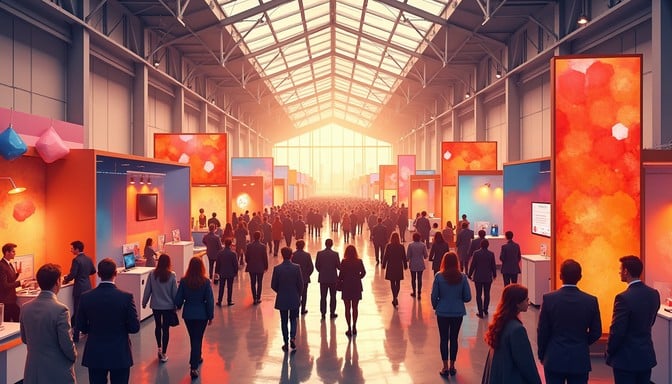
For decades, tradeshows have been one of the cornerstones of manufacturing marketing. You pick the show, reserve the booth, ship the displays, order the giveaways, print the brochures and send your sales team to spend three days shaking hands and collecting business cards. Then everyone comes home exhausted and someone inevitably asks, “How many leads did we get?”
I think that is the wrong question.
Tradeshows are not dead, but the way manufacturers approach them is changing. The old strategy was built around showing up, getting as much traffic to the booth as possible and hoping that some of those conversations eventually turned into business. That approach made sense when the tradeshow was one of the primary ways buyers discovered potential suppliers. It makes far less sense today when your prospects can research your company, compare competitors, read your content and even ask AI tools about your capabilities before they ever walk into the exhibit hall.
The tradeshow is no longer the beginning of the buyer’s research process. In many cases, it is somewhere in the middle of it. That means your strategy has to start long before the show.
Your tradeshow strategy should begin with the customer, not the booth
Instead of starting with the question, “How do we get more people into our booth?” I would start with, “Which companies and people do we actually want to meet?”
That requires some of the same customer and competitive research I encourage manufacturers to do throughout their marketing. Identify the companies you want to win. Understand what they manufacture, the markets they serve, the problems they are trying to solve and the pressures they are facing. Find the people who influence the buying decision and learn what matters to them. Then start building the relationship before the tradeshow begins.
Reach out through LinkedIn or email. Share something useful. Ask a relevant question. Invite them to meet while you are both at the show. If you know the right prospects are going to be there, don’t leave those meetings to chance.
There is a significant difference between walking into a tradeshow hoping the right people find you and walking into the show knowing you already have conversations scheduled with people who fit your ideal customer profile. One approach depends on traffic. The other depends on strategy.
Your booth is not your differentiator
Walk through a manufacturing tradeshow and you will see the same words repeated over and over again. Quality, service, innovation, on-time delivery, experience, advanced technology and family-owned are all legitimate attributes, but when every competitor is saying essentially the same thing, they stop being differentiators.
Your customer is not looking for another company that says it provides quality. They are looking for a company that understands their particular problem.
Can you help them reduce lead times? Can you take on capacity they cannot handle internally? Can you solve a difficult machining or manufacturing challenge? Can you reduce supply chain risk? Can you help them reshore work? Can you support a new product launch or help them address a quality problem that is costing them money?
Those are the conversations that create differentiation because they are connected to the customer’s reality rather than your list of capabilities. And you cannot figure that out by sitting at your desk and guessing what buyers want to hear. You figure it out by talking to customers.
Stop measuring tradeshow success by how many people scanned a badge
One of the biggest problems I see with tradeshow marketing is the emphasis on activity instead of outcomes. A crowded booth looks impressive, and a stack of scanned badges makes everyone feel like the investment was worthwhile, but neither tells you whether you actually reached the right buyers.
I would much rather see a manufacturer have 20 meaningful conversations with companies that fit its ideal customer profile than collect 500 names that have little potential to become customers.
The metrics should reflect that. How many target accounts did you engage? How many meaningful conversations did your team have? How many follow-up meetings were scheduled? How much qualified pipeline was created? What opportunities moved forward? And eventually, what revenue can be connected to the investment?
That is how you begin treating a tradeshow as a business development strategy rather than an annual marketing expense.
The most important part of the tradeshow may happen after you leave
This is where I think manufacturers have an enormous opportunity to improve their results.
The show ends, everyone gets on a plane, the leads get entered into the CRM and someone sends a generic follow-up email thanking people for stopping by the booth. Then the sales team gets busy with everything else they have going on.
Three months later, those leads are still sitting in the CRM. The problem wasn’t necessarily the tradeshow. The problem was that there was no strategy for what happened next.
If you had a meaningful conversation with a prospect about a specific challenge, your follow-up should continue that conversation. If they mentioned a capacity problem, send them something relevant to that problem. If they were interested in a particular capability, give them more information about it. If they indicated they might have a project coming up, schedule the next conversation. The follow-up should feel like a continuation of a relationship, not an automated response to a badge scan.
Think about the tradeshow as a relationship-building event
Some of the best conversations at a tradeshow never happen inside the booth. They happen over coffee, at dinner, during an educational session or while walking between meetings.
That is why I think manufacturers need to stop thinking about the booth as the center of their tradeshow strategy. The booth is one opportunity to create a conversation, but it is not the only opportunity.
You might schedule meetings with key prospects before the show. You might host a small dinner for customers and prospects. You might invite a handful of target accounts to a private discussion around a problem that affects their industry. You might use the event as an opportunity for your leadership team to meet with existing customers and strengthen those relationships.
The goal isn’t simply to get more people to walk into your booth. The goal is to create more opportunities for the right people to talk to the right people about the right problems.
The new tradeshow strategy is really a customer strategy
I don’t believe tradeshows are going away. For many manufacturers, they remain one of the best opportunities to build relationships, understand what is happening in the market and get face-to-face time with buyers who are difficult to reach any other way.
But the manufacturers that get the most from them are going to be the ones that stop treating the tradeshow as a three-day event and start treating it as one part of an ongoing sales and marketing process.
That means identifying the right accounts before the show, researching what matters to those buyers, creating a reason for them to engage, building relationships before you arrive, having meaningful conversations while you are there and having a disciplined follow-up process once you leave.
The tradeshow isn’t dead. The old tradeshow strategy is. And perhaps the biggest shift is that success is no longer about how many people you can get to notice you. It is about whether the right people already understand why they should be talking to you.